The Bay of Quinte Bird Team, in conjunction with Wild Birds Unlimited, is hoping to put together several family oriented “Birding Backpacks” that can be borrowed from the library. In support of this initiative, the team is asking for donations of old binoculars and bird field guides. The group also plans to approach Trailhead to see if we can get some light backpacks donated.
Category: Uncategorized
-
Occasional Help Needed
With another successful sale behind us, the Tree Committee is surveying last year’s plantings to make sure all remain healthy — protecting our investment, you could say. We have a small group of dedicated volunteers who help with occasional watering / weeding as needed, but could use more help. If you can spare a bit of time in a park this summer, please contact Brett Nielsen, brettnielsen4@gmail.com. Any and all help is greatly appreciated. This could also be an opportunity for a high school student who needs to earn a few more volunteer hours.
-
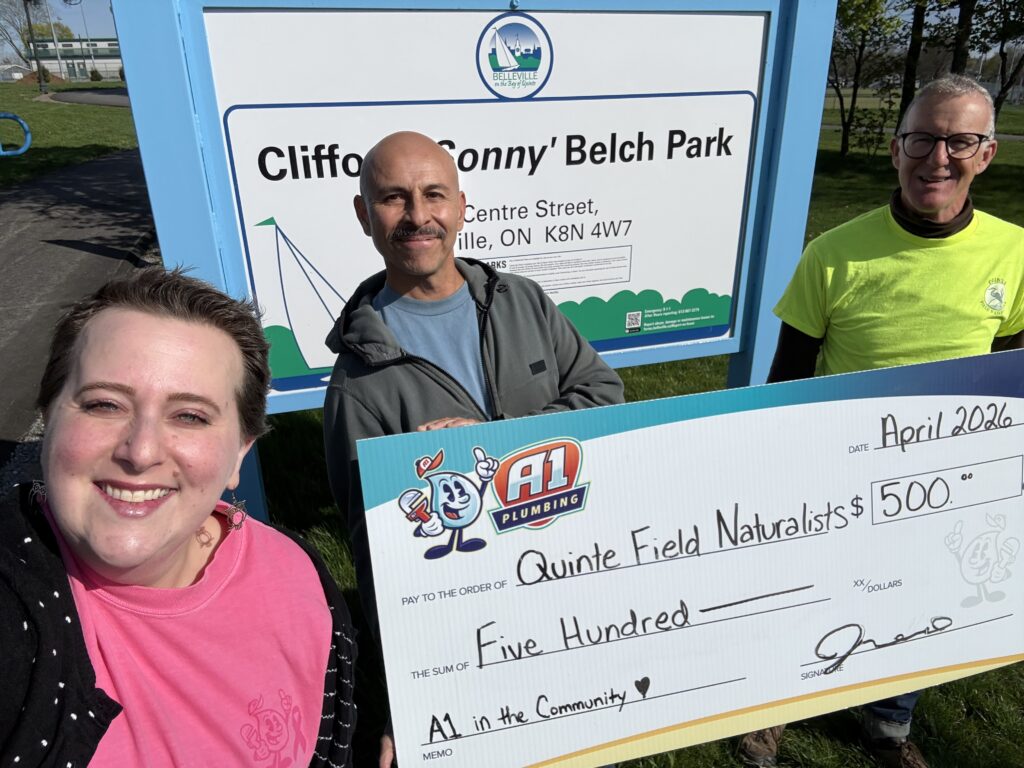
A1 In the Community Contest
Many thanks to all who supported us by voting for us in the A1 In the Community Contest. Thanks to you and the A1 Plumbing we will be planting more native trees, shrubs and flowers at local parks in the community.
-
ALTO Information
The information below is a brief summary of some of the concerns about the Alto project held by the QFN executive. While public open houses have wrapped up, the window for public participation has been extended to April 24, 2026. We encourage you to make responses and to write to your MP and MPP.
Background
The proposed high speed rail line is to run about 1000 km between Toronto and Quebec City with trains travelling at up to 300m km/h on “mainly electrified tracks.” There will be stations at Toronto, Peterborough, Ottawa, Laval, Montreal, Trois-Rivières and Quebec City. It will be a public-private partnership between a consortium of several national and international firms known as Cadence and Alto, a crown corporation. Construction on the Ottawa-Montreal section is scheduled to begin around 2029-30. Phase 1 is projected to open around 2035-38, with completion of the entire line extending to 2041-44.
Concerns
As identified by Ontario Nature, there are many issues surrounding the project, not least of which are the cost and the strain on the provincial electrical grid. The ecological risks affecting sensitive species include:
- habitat fragmentation due to the required fencing for the track,
- direct mortality (mortality increases with increasing speed),
- sensory disturbances (high frequency noise and vibration).
Northern vs Southern Route
Assuming the high-speed line will be built, QFN’s greatest concern is the choice between two proposed routes — it’s an either/or question. At Norwood (east of Peterborough), rails will either continue parallel to highway 7 or loop south through rural Hastings, Lennox and Addington, and Frontenac counties to rejoin the northern route east of Perth. A bit of an after-thought, Alto has suggested that the southern route would offer an easier/cheaper construction alternative to the northern route. Regardless, cutting a 60-meter-wide swath through either region is devastating for the environment and agriculture.
Adopting the northern route would cut through the part of the Canadian Shield known as the Land Between — ecologically intact Canadian Shield landscapes with forests, wetlands and lakes subject to localized but still considerable ecological fragmentation.
Adopting the southern route would cut through a completely different physiographic region, the St. Lawrence – Great Lakes Lowlands characterized by significantly more agricultural land. A fenced 60-metre-wide track in this area would lead to farmland loss, farm severance, disruption to drainage systems and difficult access to fields. Ecologically the southern area is a mosaic of small woodlots, hedgerows, riparian strips and wetlands both seasonal and permanent, as evidenced by our members who live in Hastings County. These are necessary as movement corridors and breeding areas for many species such as deer, fox, coyote, turtles, and amphibians. These, and areas such as the Salmon River Alvar, are already under ecological stress from development. Adding to this stress does not seem wise.
Mitigation
In their recent presentation, Ontario Nature recommended the following mitigation measures if construction were to go forward:
- Elevated Sections: Constructing the rail line on a continuous viaduct in key areas like the Southern Frontenac “pinch point” would eliminate the barrier effect of at-grade fencing, allowing for uninterrupted wildlife movement and preserving the hydrological integrity of wetland complexes below the tracks.
- Wildlife Crossing Structures: To counteract the barrier created by mandatory safety fencing, a high-density and ecologically-meaningful sequence of dedicated structures is required, including large mammal overpasses every 5–8km in critical corridors and specialized tunnels for reptiles every 300–500m to facilitate seasonal migrations.
- “No Go Zones” and Ecological Buffers: Establishing minimum 400m exclusion zones around core ecological assets like forest interiors and provincially significant wetlands would prohibit destructive “cut and fill” construction methods, thereby protecting interior forest sanctuaries and local hydrology from permanent alteration.
QFN supports Ontario Nature’s position that if the project proceeds, it must meet strict, science-based ecological performance standards.
We will support Ontario Nature in advocating to ensure the project does not become an impenetrable barrier within important ecological corridors. The climate benefits of this project must not come at the cost of habitat and biodiversity. The maps below show proximity of protected areas and areas of high biodiversity.
For more information:
https://www.altotrain.ca/en – Alto’s official website
https://www.friendsofsalmonriver.ca/ – An excellent source for information about the effects of both routes.
https://wildlifepreservation.ca/blog/concerns-for-alto/ – Expresses concern about the possible effects on one endangered species, Loggerhead Shrike.
https://altohsrcitizenresearch.ca/ – Alto HSR Citizen Research
Various Facebook Pages:
- Alto Train , Northern route discussion and awareness
- Concerned Citizens Against the Alto Southern Route
- Save South Frontenac
What You Can Do – the online consultation period has been extended to April 24th
- Submit written comments to Alto and your MP and MPP.
- Complete the public questionnaire
- Leave location-specific comments using the interactive corridor map, which allows you to pin concerns or support at exact locations (e.g., farmland, wetlands, neighbourhoods)
Official site: https://www.altotrain.ca/en/public-consultation [altotrain.ca]
-
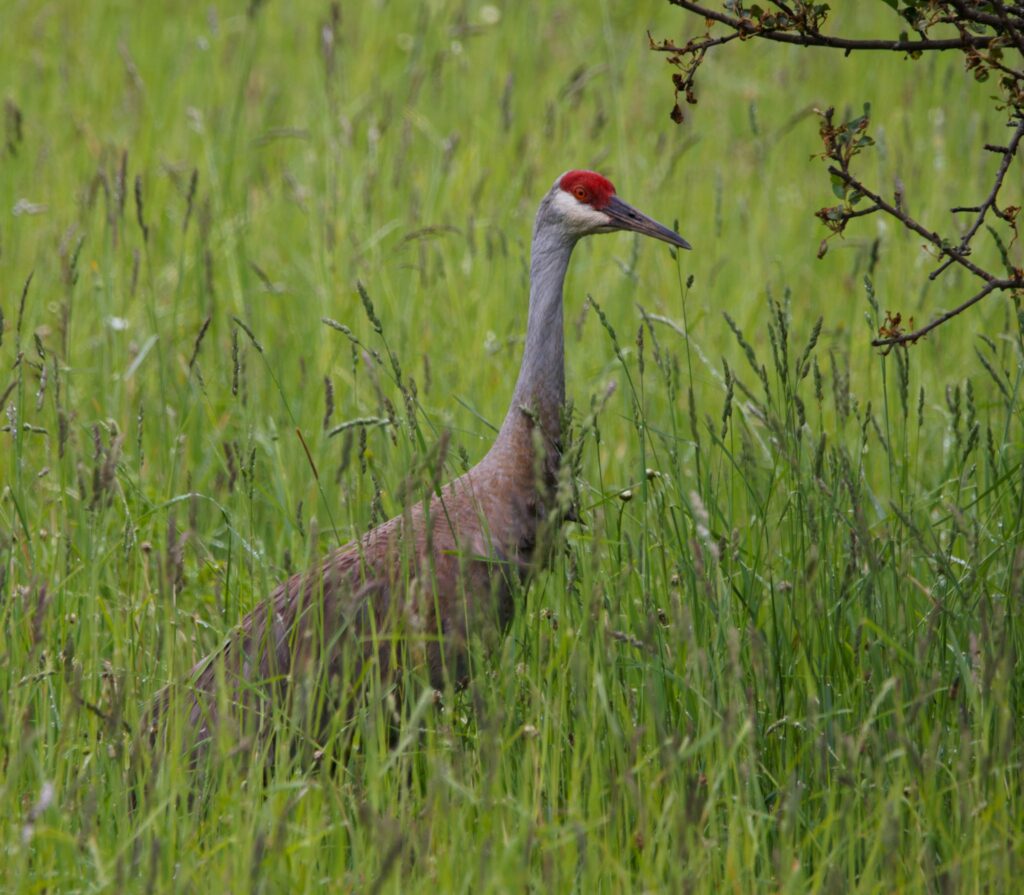
Ontario Nature Statement on Opening a Hunting Season for Sandhill Cranes
February 9, 2026
Ontario Nature is aware that Environment and Climate Change Canada (ECCC) is proposing to open a hunting season on Sandhill cranes, which is embedded in this document.
Ontario Nature, many of its Nature Network groups and individual members are concerned about this proposal. The recovery of Sandhill cranes is a conservation success story to be celebrated. Given that they were extirpated from Ontario in the last century because of overhunting, reinstating a sandhill crane hunt is an understandably controversial and concerning proposal.
-
HELP US HELP NATURE in the QUINTE REGION – RENEW YOUR QFN MEMBERSHIP TODAY
Dear QFN Member,
It is that time again – time to renew your QFN membership.
Through careful management, QFN has maintained membership dues at a reasonable rate for many, many years: $25.00 for a single membership, $40.00 for a family and $10.00 for a student.
Membership remains a great bargain! with monthly meetings from September to May filled with great speakers and interesting information about our natural world, to our Outings Program where you can explore natural areas in the region with other like-minded folks, to helping us do good for nature through a variety of activities and projects.
Look at some of the ways you helped Nature this year with your membership and volunteer work:
Our Tree Committee led by Greg Parsons planted almost $30,000 worth of native trees, shrubs and perennial flowers at Clifford “Sonny” Belch Park and Cascade Park.
Our Alcohol Container Drive led by John Lowry and assisted by Melissa Ouellet raised over $2800 dollars to protect land through the Nature Conservancy of Canada. With our donation of $500, plus a few smaller donations, the total came to $3530.
We supported Think Turtle with $500.00 to help our local turtles.
We continue to support Sandy Pines, this year with $300.00 toward the rehabilitation of injured wildlife.
We donated $500 to the Wildlife Preservation Society to support the continued survival of the Loggerhead Shrike.
We supported ON Nature with over $500.00 to support their operations and the Youth Summit.
Ted Pordham continues to Feed our Feathered Friends at the Frink Centre (we donated $230.00 for bird seed in 2025).
We continue to advocate to preserve our local wetlands, natural spaces and native species through letter writing, deputations and education throughout the Quinte area.
If you feel as we do that Nature needs our assistance to thrive, please renew your membership bye-transfer to qfnnature@gmail.com,
cheque payable to “Quinte Field Naturalists”
mail to Dan Guenther, 1492 County Rd 28, Brighton ON, K0K 1H0
or at our next meeting January 19th, 2026
We are most grateful for your past contributions and thank you for your continued support.If you have any questions, suggestions or concerns, please contact Nancy Stevenson at nlsriver@gmail.com .
Best wishes for 2026
from your QFN Board.
-
Ontario Court Strikes Down Mississauga Lawn By-law as Unconstitutional
The Ontario Superior Court has ruled that Mississauga’s Tall Grass and Nuisance Weeds By-law 125-2017 violates the Charter right to Freedom of Expression, setting an important precedent for environmental stewardship and municipal accountability.
CBC News Report · Posted: Jan 09, 2026 5:02 PM EST
When most people think of freedom of expression, they picture protests, newspapers, or social media posts. Few imagine a front yard. Yet on January 6, 2026, the Ontario Superior Court confirmed something quietly profound: how we care for our own land can be a form of expression protected by the Canadian Charter of Rights and Freedoms.
In its Ruck v. City of Mississauga ruling, the Court struck down key provisions of Mississauga’s Tall Grass and Nuisance Weed By-law, finding that they unjustifiably infringed freedom of expression. The ruling did not say municipalities can never regulate lawns or vegetation. It said something more important — that governments must justify restrictions on expression with evidence, not assumptions.
At the heart of the case was a simple question: can a person choose to naturalize their property, allowing weeds and grasses to grow, in order to express environmental values about biodiversity, respect for nature and coexistence with wildlife? The Court’s answer was yes. Gardening, the judge held, can carry expressive meaning, especially when it is undertaken deliberately to communicate ideas about ecology and stewardship.
That recognition matters. Our homes are not just private spaces; they are also places where values are lived and expressed. Expression at the home, the Court emphasized, deserves serious constitutional protection. When a municipality orders that expression to be cut down — literally — it must be able to show why.
Mississauga argued that its by law was necessary for health, safety, and neighbourhood standards. The Court accepted that these objectives are important and can be legitimate. But under Canada’s constitutional framework, that is only the beginning of the analysis. The City was required to demonstrate that its specific rules — including a strict 20 centimetre height limit and categorical removal of listed plants — minimally impaired freedom of expression.
It could not.
The City provided no evidence that it had searched for less restrictive alternatives. It relied largely on the fact that other municipalities had similar by-laws. That was not enough. As the Court made clear, copying what others do does not satisfy the Charter. Governments must turn their minds to constitutional limits and provide proof of their compliance.
This is not a radical idea. It is the essence of constitutional democracy. Rights are not obstacles to governance; they are guardrails that ensure power is exercised carefully, proportionately, and transparently.
The ruling also dispels a common misconception. It does not give anyone a free pass to ignore legitimate safety concerns. Nor does it require cities to abandon property standards altogether. What it does require is balance — and evidence.
At a time when communities across Ontario are grappling with biodiversity loss, climate change, and the need for more resilient urban ecosystems, the decision offers a constructive path forward. Municipalities can regulate. Residents can steward. And both must respect constitutional rights.
Perhaps most importantly, the case reminds us that the Charter is not an abstract document reserved for grand political disputes. It lives in everyday decisions — including how we shape the land around our homes. When courts protect those spaces of expression, they protect something fundamental: the freedom to live our values where it matters most.
When a lawn becomes a Charter issue, it’s not about grass — it’s about freedom of expression at home.
Source: https://wolfruck.com/ontario-court-strikes-down-mississauga-lawn-by-law-as-unconstitutional/?fbclid=IwdGRzaAPMA1hjbGNrA8wDPWV4dG4DYWVtAjExAHNydGMGYXBwX2lkDDM1MDY4NTUzMTcyOAABHmgpdScyrYRmN8RVcMSu_xhdTpMyiSIwtm_szkqJTq5iSQwuLi3Gd2A3hEkK_aem_ZGA5yEOrrC3Wh_ceKs_kNA&sfnsn=mo
-
January 5th, 2026 – Letter Support for Belleville to Becme a Bird Friendly City
Dear Mayor Ellis & Councillors Kelly, Enright-Miller Seu, Brown, Chatten, Henderson , Carr & Thompson,
I am writing to you on behalf of QFN’s 188 members, 266 friends and 24 project advocates. QFN engages in conservation projects and supports other organizations in their conservation efforts in order to support and promote biodiversity in the Quinte Region. Biodiversity is our greatest natural defense against climate change: healthy ecosystems populated with a diversity of species have the the potential to significantly reduce the costs which can be incurred by natural disasters.
QFN is extremely pleased that the City of Belleville is considering becoming a Bird Friendly City. This proactive decision would help to maintain a diversity of healthy avian populations throughout the area which would provide crucial environmental benefits like pest control, pollination and seed dispersal as well as offering Humans the enjoyment of bird watching and learning more about different species of birds. Birds powerfully connect people with nature by providing accessible beauty, sound and activity. Their presence culminates in people caring more about protecting the environments where birds live. Designating Belleville as a Bird Friendly City would be a positive development for all life in the community.
In addition to advocating for increased support of birds in the area through the establishment of a Bird Friendly City status, QFN wishes to continue working with the City of Belleville, adding greenspace to the urban environment. QFN’s Tree Committee, under the leadership of Greg Parsons, has been working hard over the past three years to obtain funding for the planting of native trees and shrubs, and herbaceous pollinator plants. We understand that the City has had to decrease the funding allotted to tree planting and to parks due to financial concerns. Despite this barrier, we trust that we can continue to work with the City of Belleville to expand and enrich the greenspace throughout the urban environment.
QFN highly recommends the continued addition of trees to the City of Belleville because of their great contributions to the quality of life and their significant economic benefits. Trees offer immense benefits by cleaning air and water, combating climate change through carbon absorption, cooling urban areas with their shade, managing stormwater, and preventing erosion. Furthermore, they provide essential habitats for wildlife, boost human physical and mental health, create economic value through energy savings, and enhance community aesthetics and social connection. The City of Belleville and its inhabitants deserve to be recipients of all of the advantages offered by a diversity of native trees.
QFN trusts that we can continue to work with you and city staff in increasing the biodiversity across Belleville through tree planting and pollinator garden initiatives. We also are relying on you to support biodiversity and the quality of city life by committing to Belleville becoming a Bird Friendly City. These initiatives have the potential to attract individuals, families and businesses who are contemplating a move to the area. Achieving the status of a Bird Friendly City would also help to strengthen corridors and provide regional support for our neighbours in Kingston and Peterborough who, as Bird Friendly Cities, are working hard to make their urban ecosystems more resilient.
Thank you for your attention to our request, and for all that you are doing to enrich life in Belleville by attending to the natural environment.
Sincerely,
Dr. Elizabeth Churcher
QFN Corresponding Secretary -
Quinte Bird Friendly City needs your help
We hope everyone is having a wonderful holiday season. But even though the holidays are upon us, Nature still needs our voice!
The Quinte Bird Friendly City will be presenting to Belleville Council on Monday Jan 12th at 4 PM. Our own Dan Guenther will be giving a 10 min presentation to council in hopes that council will pass a Motion supporting our initiative to have Belleville become a Bird Friendly City. Councillor Garnet Thompson has been invaluable in moving this project forward and Councillor Barb Enright-Miller as chair of the Green Task Force has also been helpful in bringing this project to council. We very much would like to have some Quinte Field Naturalists in the gallery at City Hall for this presentation so that council is aware that people care about our local birds. In addition, we would love it if you can spare a few minutes to email the local council and mayor about how important it is to support nature in our community. See sample email attached.
Of course, QFN is also active in planting as many native trees, shrubs and pollinator plants on the landscape as we can. Unfortunately, with budgets tight throughout Ontario municipalities we hear that the funds for Tree Planting in Belleville have been greatly reduced. Our Tree Planting Committee led by Greg Parsons has been working hard together with the Quinte Urban Forest Network and Quinte Conservation to apply for a large Green Municipalities Grant. This grant (soon to disappear but still has funds to disperse this year) matches money from municipalities, nonprofits and charities to support the tree planting across Canada. Lindsay Nash through Quinte Conservation is doing the legwork to apply for this grant and did speak with Belleville municipal staff about having them participate in the grant application. In essence it would double the amount of money the city has for tree planting. Unfortunately, the answer from staff was that they were uninterested in collaborating with us on the grant.
If you feel, as I do, that we need to plant as many native trees on the landscape as quickly as we can, I hope you might consider writing a letter to our local councillors asking them to consider doing more tree planting and working with Quinte Conservation to facilitate this endeavor.
Thank you for your time. I hope you might find a few minutes to advocate on behalf of nature!
Wishing a very Happy New Year,
Lori Borthwick
Advocacy,
QFN
-
2025 QFN Alcohol Container Drive Final Tally
The final tally is in!
2025 was a very successful year for the Quinte Field Naturalists’ alcohol container collection drive. When everything was cashed in and the monies tallied, we raised
$3,530.00!!!
Your gift was donated to the Nature Conservancy of Canada on ‘Giving Tuesday’, December 2nd, thereby effectively doubling our contribution.
Coupled with last years contribution (also donated on Giving Tuesday) the QFN has put over $16,000 into the NCC’s coffers – all of which is earmarked to support local conservation efforts in the Quinte region.
A HUGE thank you to all those who collected and contributed. It really was a team effort.
The best of the season to you,
John Lowry